
Cooling Strategies for High-Density Server Rooms

Facebook
Twitter
LinkedIn
WhatsApp


Cooling Strategies for High-Density Server Rooms

As data centers evolve to support higher computational loads, server density continues to rise. High-density server rooms—with racks consuming hundreds of kilowatts per rack—pose a significant challenge: heat management. Without effective cooling strategies, servers can overheat, leading to hardware failure, reduced lifespan, downtime, and increased energy costs.

In this blog, we explore effective cooling strategies for high-density server rooms to ensure reliability, efficiency, and scalability.


Why Cooling is Critical in High-Density Environments

  1. Prevent Hardware Failure
    • Excessive heat can damage CPUs, memory modules, power supplies, and storage devices.
  2. Ensure Operational Continuity
    • Overheating triggers server throttling or shutdowns, impacting uptime.
  3. Maintain Energy Efficiency
    • Poor cooling increases reliance on air conditioning, inflating electricity bills.
  4. Support Future Expansion
    • Scalable cooling solutions are essential for growth in IT workloads.


Key Cooling Strategies

  1. Hot Aisle / Cold Aisle Containment
  • Layout: Arrange racks so that cold air intakes face one aisle (cold aisle) and hot air exhausts face another (hot aisle).
  • Benefits:
    • Prevents hot and cold air mixing
    • Improves cooling efficienc
    • Reduces overall energy consumption

TIP: Use physical containment panels or curtains for more precise airflow management.

also read: Why a UPS is Essential for Video Surveillance Systems 

  1. Raised Floor Systems
  • Raised floors allow underfloor plenum distribution of chilled air directly to server inlets.
  • Advantages:
    • Uniform cooling distribution
    • Flexible airflow adjustments
    • Easy cable and power management underneath

Note: Ensure perforated tiles are strategically placed to avoid hotspots.


  1. Overhead or Rear Door Cooling
  • Overhead cooling units deliver cold air directly above racks.
  • Rear-door heat exchangers capture hot exhaust air and cool it before it returns to the room.
  • Benefits:
    • Reduces load on traditional CRAC/CRAH units
    • Minimizes room-wide temperature fluctuations


  1. In-Row Cooling
  • Cooling units installed between server racks to provide localized, high-density cooling.
  • Ideal for racks with >10 kW per rack.
  • Benefits:
    • Reduces ducting losses
    • Efficient for targeted hot spots


  1. Liquid Cooling Solutions
  • Direct-to-chip liquid cooling or immersion cooling is gaining popularity for high-density servers.
  • Benefits:
    • Higher thermal transfer efficiency than air
    • Supports extremely dense workloads (>50 kW per rack)
    • Reduces energy consumption from air conditioning

Consideration: Requires upfront investment and specialized infrastructure.
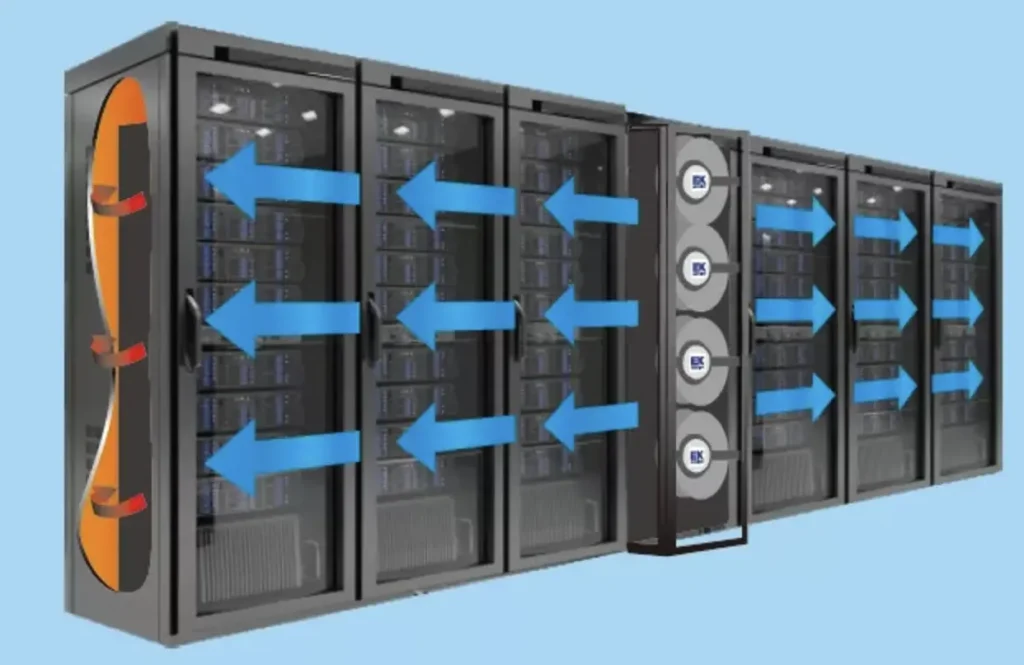
 

  1. Free Cooling / Economizer Modes
  • Use outside ambient air or chilled water from low-temperature sources to reduce reliance on mechanical cooling.
  • Seasonal benefits: Significant energy savings in cooler climates.


  1. Intelligent Monitoring and Control
  • Deploy sensors and DCIM software to monitor temperature, humidity, and airflow.
  • Adjust cooling dynamically based on server load and environmental conditions.
  • Benefits:
    • Prevents hotspots
    • Optimizes energy consumption
    • Improves PUE (Power Usage Effectiveness)


  1. Redundancy and Reliability
  • High-density server rooms require N+1 or 2N redundancy in cooling units.
  • Ensures that a single failure does not impact operations.
  • Critical for Tier III and IV data centers.


cooling-server-cabinets-with-lateral-airflow-illustration

Best Practices for High-Density Server Cooling

  1. Maintain hot aisle/cold aisle separation with containment for maximum efficiency.
  2. Optimize rack placement to balance airflow.
  3. Use blanking panels to prevent recirculation of hot air.
  4. Monitor temperature at multiple points—top, middle, and bottom of racks.
  5. Evaluate liquid cooling for racks exceeding 20–30 kW per rack.
  6. Plan for future scalability in airflow and cooling capacity.


Why Choose ACDCIS?

  • Expertise: Specialized in supplying uninterruptible power supplies (UPS), batteries, measuring instruments, and data center solutions.
  • Quality: Offering high-quality, affordable solutions for critical data center infrastructures.
  • Reliability: Aspiring to be the reliable partner in your seamless critical operations.


Our Products & Services

ACDCIS provides a wide array of products and services tailored to meet the specific needs of data centers:

  • UPS Systems: Ensuring continuous power supply during outages.
  • Batteries: Offering various types of batteries for backup power.
  • Precision Cooling Units: Maintaining optimal temperatures for equipment.
  • Power Distribution Units (PDUs): Efficiently distributing electrical power.
  • Environmental Monitoring Systems: Monitoring critical parameters to safeguard infrastructure.


Contact Us

For inquiries or to request a quote, please contact us at:


About ACDC:

ACDC Integrated Electrical Solutions is your trusted partner for data center solutions in the UAE, committed to ensuring the reliability and efficiency of your critical infrastructure


Facebook
Twitter
LinkedIn
WhatsApp